Warns of 'short-term pain' as employers reduce workforces in favour of AI technologies

Artificial intelligence is poised to trigger a turbulent decade in Canada’s labour market, with significant job losses expected before longer-term employment gains materialise, according to a new report from the Conference Board of Canada.
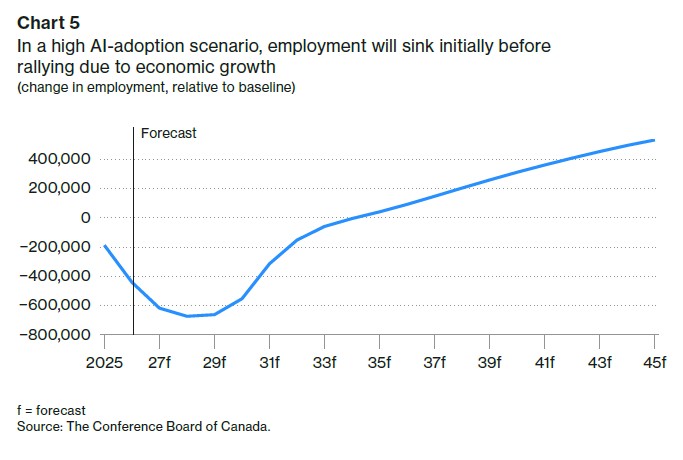
In a high AI-adoption scenario, the think tank projects that total employment will initially fall well below its current outlook before rebounding and ultimately exceeding it.
“In total, in this full-adoption scenario, we estimate that employment increases by 2.1 per cent in 2045 (or about 535,000 additional jobs) compared with our baseline forecast,” the report states. “This long-term growth would offset an estimated initial drop in employment of 2.6 per cent in 2030, or about 555,000 jobs.”
In the near term, the Conference Board warns of “short-term pain as businesses reduce their workforce in favour of AI technologies.” Under its scenario, total employment in 2030 is expected to be “535,000 jobs below our baseline forecast,” reflecting employers’ efforts to capture efficiency gains by automating tasks that can be performed by AI and related tools.
Chief human resources officers have identified AI transformation as their top priority for 2026, according to research published by Gartner.
J‑curve for employment
The report, Understanding the Influence of AI on Employment, examines how automation technologies, including AI, affect jobs through three channels:
- exposure of tasks to automation
- resulting productivity gains
- the likelihood that work is actually replaced by technology.
The employment path over the next 20 years is a pronounced J‑curve: a deep dip followed by a gradual but sustained rise. The Conference Board — which is rebranding to Signal49 Research as of Jan. 26, 2026 — summarises the trajectory as an “initial drop in employment of 2.6 per cent in 2030” that is later outweighed by “long-term growth” in jobs as the benefits of AI-enabled productivity are realised.
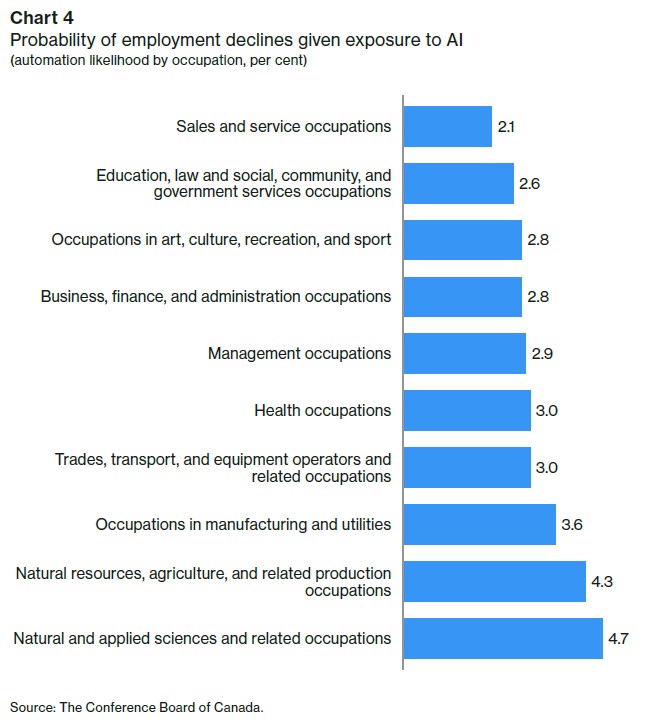
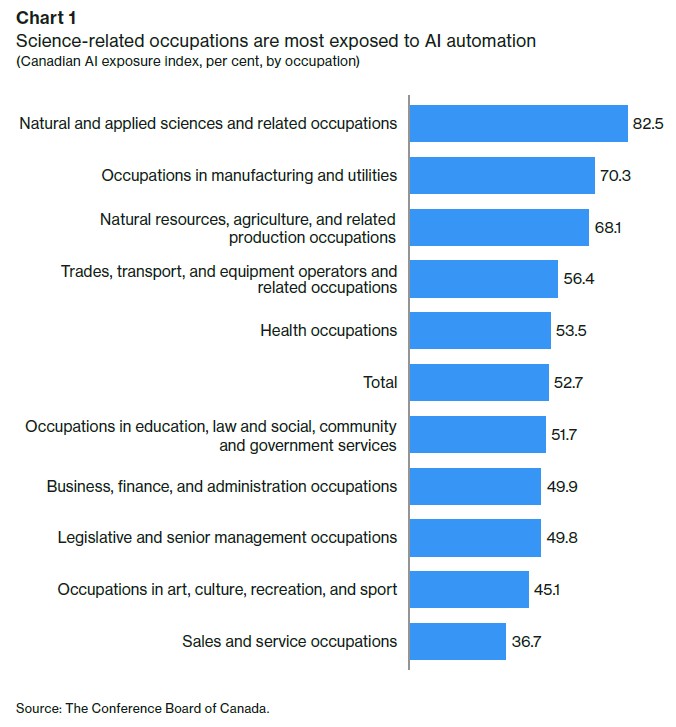
The report links the early job losses to the substantial share of work that is technically automatable. It estimates that “over half of tasks performed (53 per cent) across all occupations in Canada could be performed by current artificial intelligence technologies.”
 According to The Conference Board, the story changes as productivity gains ripple through the broader economy. As AI and automation raise output per worker, incomes rise, consumption increases and new demand for goods and services emerges.
“Given that the underlying population does not change, the long-term employment gains mean that more people participate in the labour force in the long run than in our base case,” the report notes, adding that the scenario is also “accompanied by a decline in the unemployment rate.”
By 2045, those dynamics more than compensate for the earlier losses. The report’s modelling suggests that, once AI adoption is fully absorbed, the Canadian economy will support roughly 535,000 more jobs than under its baseline forecast without the additional productivity boost.
Currently, AI and automation are having a limited impact on hiring, according to a previous report.
Task-level automation, not just job elimination
The Conference Board stresses that these shifts reflect automation at the task level rather than the elimination of whole occupations. Automation “proceeds at the task level,” the report says, and “it is tasks that are replaced or augmented by technology, and the occupation—which is a collection of required tasks—may shift as a result of its underlying tasks.”
That dynamic helps explain why some jobs grow even in an era of widespread automation: their most automatable tasks are offloaded to technology, while demand for the remaining human-centred work rises with overall economic growth.
The report also cautions against assuming that every productivity gain translates directly into job cuts. It notes that if AI halves the time needed to complete a task, employers might choose to ask workers to do twice as much of that task instead of reducing headcount.
“The amount of work is not necessarily fixed, and therefore the net employment impact would be different than what the automation likelihood might suggest on its own,” according to the Conference Board.
Canadian firms are banking on AI to boost efficiency while they try to manage tariff‑driven cost pressures, according to a previous study.
Winners and losers in 2045
Not all occupations are affected equally across this bumpy decade, according to the Conference Board’s report. People-facing roles that are less directly exposed to automation but benefit from stronger overall economic growth tend to be among the long-run winners.
In 2045, food-counter attendants, kitchen helpers and related support occupations are projected to have 21,187 more jobs than in the baseline; retail salespersons and visual merchandisers, 20,972 more; transport truck drivers, 15,978 more; nurse aides, orderlies and patient service associates, 15,318 more; and construction trades helpers and labourers, 9,591 more.
By contrast, some roles see net declines even once the economy has fully adjusted. The report identifies managers in agriculture (569 fewer jobs than baseline), health policy researchers, consultants and programme officers (935 fewer), specialised livestock workers and farm machinery operators (1,390 fewer), real estate agents and salespersons (1,758 fewer), and water and waste treatment plant operators (5,708 fewer) among those expected to experience job losses relative to the non‑AI scenario.