New report offers valuable advice amid 'really exciting' shifts in performance management

Introducing a mid-year review cycle can be the "most impactful addition" that HR leaders can make in their employee performance management strategy, according to a new report.
Advice from the 2027 State of HR Report from PerformYard, a performance management software provider, underscored the need to add a second review cycle a year to boost outcomes in the organisation.
"Adding a second review cycle makes the biggest difference," the report read.
It pointed out that increasing the number of reviews is the "first step" on a path organisations take as they mature, going from two cycles in their first year to five cycles by their fifth year.
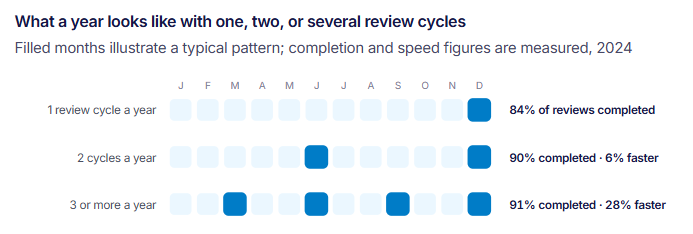
"Going from one review cycle a year to two raises the review completion percentage from 84% to 90%. Organisations running three or more cycles a year also finish each review 28% faster than organisations running one," the report read.
'Exciting' shift in performance management
The advice comes in the wake of a "really exciting" shift in how managers assess employee performance, where review forms are shorter but delivered more frequently.
"We are seeing a really exciting change in how employee performance is managed," said Sean Dunn, CEO of PerformYard.
The findings revealed that a typical performance review now has fewer questions, down from 17 in 2022 to 14 in 2026. Despite this, the typical written answers gathered from these fewer questions have grown 25% longer over the same period.
"Over the last few years we've observed a shift toward ongoing performance conversations throughout the year. More touchpoints means more opportunities to coach employees, which leads to quicker career development, and tangible organisational output," Dunn said.
In the wake of this shift, the report also advised HR leaders to keep reviews at around 10 to 15 questions, with some open-ended questions included and three to five written prompts.
"When review forms are shorter, 91% of reviews get completed. When review forms are longer, 85% get completed," the report read.
"The organisations with the highest goal completion rates use shorter forms and get longer answers; those with the lowest goal completion rates use longer forms and get shorter answers."