Tech giant to slash even more jobs in structural shift

Meta Platforms announced on Thursday that it would eliminate approximately 8,000 jobs — 10% of its global workforce — and abandon plans to fill a further 6,000 open roles, in the most significant single restructuring the social media giant has undertaken since its self-declared "year of efficiency" in 2023.
The cuts, which will take effect on May 20, were disclosed in an internal memo to staff and confirmed by a company spokesman. They arrive not as a response to financial distress but as a deliberate reallocation: the company is stripping labor costs from one side of its balance sheet to fund an AI infrastructure program on the other that analysts estimate could reach $135 billion this year alone.
For human resources professionals, the announcement carries a particular resonance. Including Thursday's round, Zuckerberg has now overseen the elimination of roughly 33,000 positions since 2022 — a cumulative total that includes 11,000 cuts in late 2022, 10,000 more in 2023, approximately 3,600 in early 2025, and the 8,000 announced on Thursday. Each round has been framed differently. The 2022 cuts corrected pandemic over-hiring. The 2025 round was presented as performance management. Thursday's announcement is something new: an explicit statement that headcount is being traded for compute.
The numbers behind the decision
Meta's financial position makes the scale of the cuts striking. The company reported full-year 2025 revenue of $200.97 billion, up 22% year over year, and fourth-quarter net income of $22.77 billion, beating analyst expectations. Free cash flow for the year reached $43.6 billion. The stock rose nearly 10% after those earnings were reported in January.
The pressure is not coming from the income statement. It is coming from the capital expenditure plan. Meta has committed to spending between $115 billion and $135 billion on AI infrastructure in 2026 — nearly double the $72.2 billion it spent in 2025, itself a record. That spending is directed at data centers, semiconductors, GPU clusters, and infrastructure to support its Llama models and recommendation systems, including a reported $27 billion joint venture with Nebius for a gigawatt-scale AI data center campus in Louisiana.
The internal memo from Janelle Gale, Meta's chief people officer, was direct about the tradeoff. "We're doing this as part of our continued effort to run the company more efficiently and to allow us to offset the other investments we're making," she wrote. "This is not an easy tradeoff and it will mean letting go of people who have made meaningful contributions to Meta during their time here."
Bank of America has estimated that the restructuring could generate $7 billion to $8 billion in annualized savings — a fraction of one year's capital expenditure, but a meaningful contribution to the margin profile that Meta's chief financial officer Susan Li has pledged to protect. Li told investors in January that despite the "significant acceleration in infrastructure expense growth," Meta expected to deliver operating income above its 2025 level.

A structural shift, not a correction
What distinguishes Thursday's announcement from Meta's previous rounds of cuts is the strategic rationale. In 2022, Zuckerberg was correcting a mistake — the pandemic-era hiring surge that had left Meta bloated and exposed when digital advertising softened. In 2025, the cuts were framed in the language of performance management, targeting what the company described as the bottom tier of its workforce by output rating, a process that drew criticism when high performers were nonetheless caught in the reductions.
This round is different. The teams affected span recruiting, sales, middle management, and non-AI-adjacent product roles. Reality Labs, the company's virtual reality division, has already seen its budget cut by 30% and its headcount reduced by roughly 1,000 earlier this year. The May layoffs represent a shift from targeted reductions to a company-wide restructuring that touches every major business unit.
Meta is simultaneously reorganizing surviving employees into what internal documents describe as AI-focused "pods" under the Superintelligence Labs division, led by 28-year-old chief AI officer Alexandr Wang. Zuckerberg has been explicit about the vision driving the reorganization: that a small number of talented people working alongside powerful AI systems can accomplish what previously required entire departments. He has described developing AI-powered products that amount to a kind of "personal superintelligence" for billions of users.
The May round is described internally as the first phase. A second wave of cuts is planned for the second half of 2026, though its timing and scale have not been finalized. Earlier reports by Reuters, which Meta called "speculative," suggested the total reduction could eventually reach 20% of the company.
What HR leaders need to know
For people professionals managing workforces in or adjacent to the technology sector, Meta's announcement is the fourth major restructuring headline of 2026 in as many months. Oracle cut an estimated 30,000 employees in March. Amazon eliminated 16,000 corporate roles in January. Microsoft on Thursday announced its first-ever voluntary retirement program, offering buyouts to roughly 7% of its U.S. workforce. Across the sector, the technology industry has shed more than 95,000 jobs across 247 separate layoff events in 2026 — an average of 882 positions per day, according to data from Trueup.
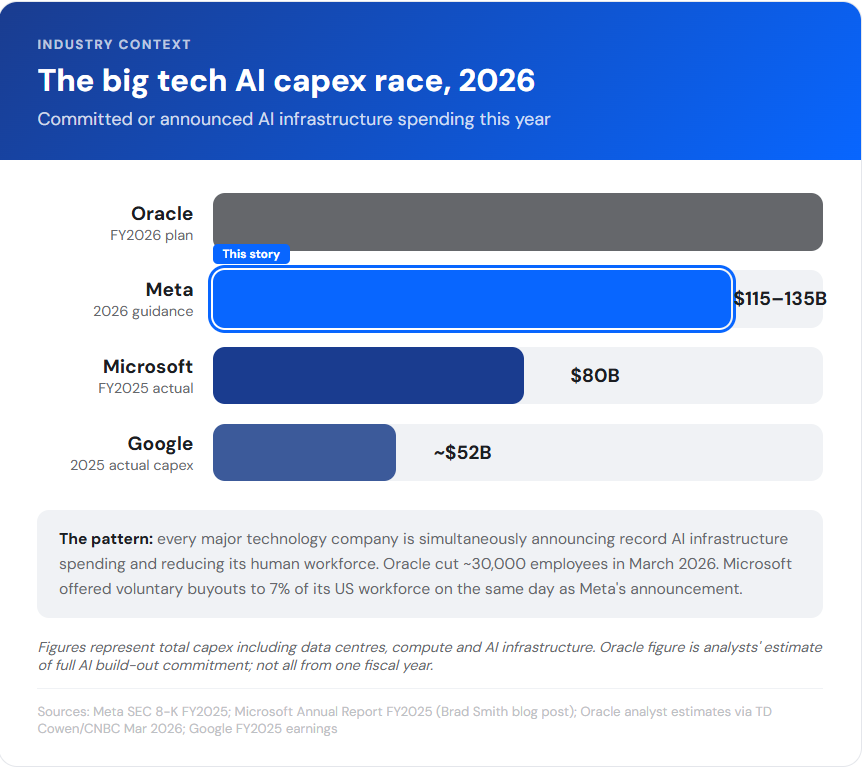
The framing across all of these announcements shares a common thread: the cuts are not a signal of weakness but of reallocation. Companies are reporting record revenues and cutting headcount simultaneously, a combination that resets the assumptions HR teams have historically used to anticipate restructuring risk.
Several HR-specific implications deserve attention.
The severance benchmark matters. Meta's 2022 layoffs established a package of 16 weeks of base pay plus two additional weeks per year of service, with no cap, along with payment of remaining paid time off. The company has not publicly confirmed whether the 2026 rounds will use the same formula, and the HR Digest has noted that previous rounds at Meta created lasting stigma around the "performance" label used to describe affected employees. Thursday's memo used different language — emphasizing contribution rather than performance shortfall — a deliberate signal that this round is strategic rather than evaluative. HR professionals advising affected employees should note that severance agreements at major technology employers are negotiable, particularly where potential legal claims exist, and that employees aged 40 or over are entitled to a 21-day consideration period under the Age Discrimination in Employment Act before signing a separation agreement.
The "survivor" workforce requires management. Meta's repeated cycles of expansion and contraction since 2022 have created what workforce analysts describe as an environment of chronic uncertainty. Those who remain after the May cuts will be working alongside a reorganized structure, under new AI-pod leadership, with a manager-to-employee ratio that some internal reports suggest could reach 1:50 in certain divisions. Research consistently links high-frequency restructuring to declining engagement and productivity among retained staff. Meta's CTO Andrew Bosworth convened a mandatory in-person all-hands meeting to communicate the rationale behind earlier 2026 rounds — a departure from the opacity that generated significant internal backlash in previous years. Whether that approach extends to the May round will be watched closely.
The skills transition is accelerating. The roles being eliminated at Meta are concentrated in areas that AI-powered systems are being built to replicate: content moderation at scale, certain sales support functions, mid-level program management, and non-specialist engineering roles. The roles Meta is actively hiring for — at salaries between $62,000 for entry-level positions and $240,000 or more for senior AI research scientists — are almost entirely in machine learning, infrastructure engineering, computer vision, and natural language processing. The gap between the roles being lost and the roles being created is one that most affected workers cannot bridge through incremental upskilling.

The broader question
Meta's announcement on Thursday does not exist in isolation. It is the clearest articulation yet of a calculus that is reshaping the technology labor market: that the return on investment from AI infrastructure, measured in advertising yield, recommendation accuracy, and product velocity, is expected to exceed the return on equivalent investment in human labor.
Zuckerberg has defended that position with financial evidence. The fourth quarter of 2025 saw revenue rise 24%, which he attributed directly to AI investments improving ad targeting and content recommendations. Whether the next phase of the bet — the $135 billion infrastructure program — yields comparable returns is the question that will determine whether 2026 is remembered as the year technology companies transformed their workforces, or the year they made a very expensive mistake.
For the 8,000 people receiving notifications on May 20, neither framing will offer much consolation. For HR leaders and people professionals, the more useful question is whether their own organizations are thinking clearly about the gap between what AI can already do, what it will be able to do in three years, and how to manage the human cost of closing that distance.
Meta employed 78,865 people globally at the end of 2025. Further rounds of layoffs are expected in the second half of 2026. The company's next earnings call is scheduled for April 29.